What is agentic commerce? What AI buying means for shoppers
AI assistants are moving from recommending products to preparing and completing checkout. Here is what agentic commerce means, what you can use today, and what to check before letting an AI buy for you.

In this article
- What does “agentic commerce” actually mean?
- What can shoppers actually do today?
- How do agents talk to shops? The protocols, simply explained
- How is a purchase approved when an AI is doing the shopping?
- Do people actually want AI to buy for them?
- What are the risks for shoppers?
- What should you check before letting an AI assistant buy something?
- Who is agentic commerce useful for right now, and who should wait?
- Agentic commerce: FAQs
- Sources
Agentic commerce: the short answer
Agentic commerce means AI assistants that do more of the shopping for you: finding products, comparing sellers and, increasingly, starting or completing checkout on your behalf. Behind the scenes, companies such as OpenAI, Google, Visa and Mastercard are building shared rules so agents can talk to shops and payment systems safely. For shoppers, the key questions are who approves the purchase, who is the seller, and who handles returns.
“Agentic commerce” has become one of the most used phrases in retail and payments in 2026. You will see it in announcements from AI companies, card networks and big retailers. But few people explain the term from the point of view of the person actually buying things.
In simple terms, it describes shopping where an AI agent does part of the work that you would normally do yourself: searching, comparing, filling in a cart, and sometimes paying. The rest of the jargon, including protocols, mandates and agentic tokens, is plumbing designed to make that safe and reliable.
This explainer covers what agentic commerce means and what consumers can actually use as of September 2026. It also explains how payment and approval should work, and which questions to ask before you let an assistant buy anything. It is based on company announcements, help pages and reputable reporting; TheJusGrow has not tested these shopping features for this article.
What does “agentic commerce” actually mean?
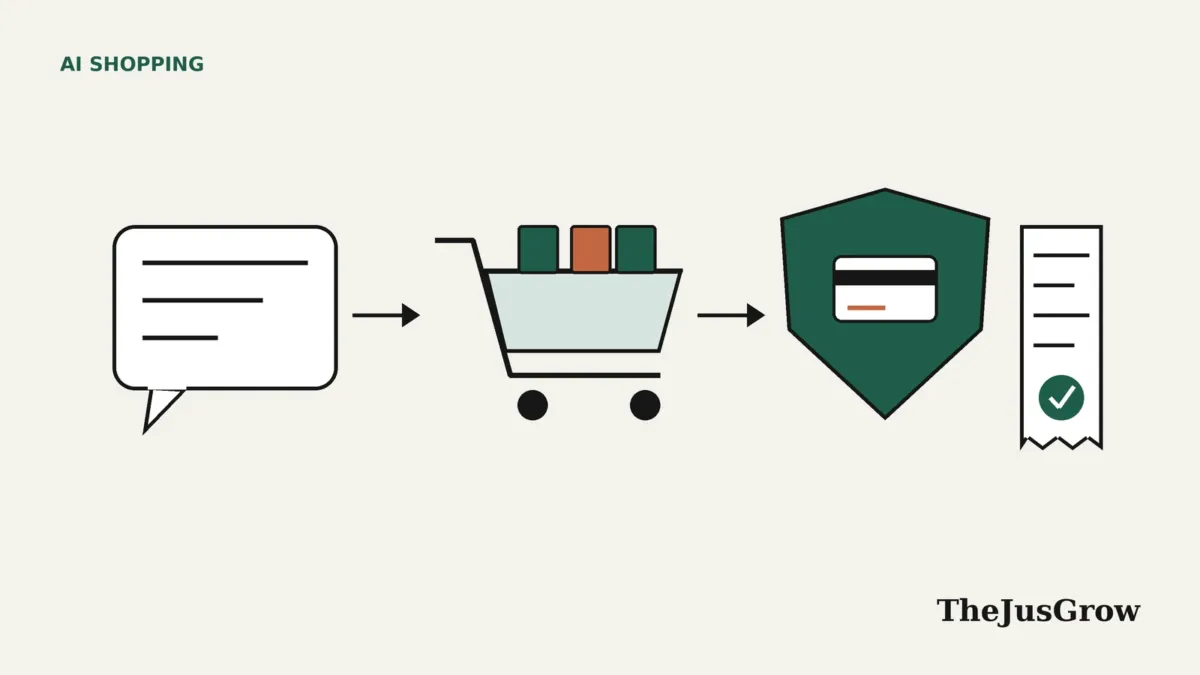
Traditional online shopping assumes a person clicks every button. You search, open product pages, add to basket, type your address and confirm payment. Agentic commerce assumes software makes some of those clicks, acting on your instructions.
It helps to think of it as a spectrum rather than one thing:
| Level | What the AI does | Who presses “buy” | Examples in 2026 (per company announcements) |
|---|---|---|---|
| Assisted discovery | Finds and compares products, summarises reviews | You, on the shop’s own site | Shopping results in ChatGPT and Google AI Mode |
| Assisted checkout | Builds a cart and hands you a pre-filled checkout | You, after reviewing the order | Checkout from eligible retailers in Google AI Mode and Gemini; merchant apps in ChatGPT |
| Delegated purchase | Buys when conditions you set are met | The agent, within limits you approved | Described in Google’s AP2 protocol; still early for consumers |
Most of what consumers can use today sits in the first two rows. Fully delegated buying, where you are not present when the purchase happens, is the part the payment industry is still building safeguards for. For a broader look at the tools available, see our guide to AI shopping agents.
What can shoppers actually do today?
The picture has changed quickly over the past year, so dates matter here.
OpenAI and ChatGPT
In September 2025, OpenAI launched Instant Checkout, which let US ChatGPT users buy from Etsy sellers inside the chat, with Shopify merchants promised to follow. It also published the Agentic Commerce Protocol, developed with Stripe, as an open standard for connecting AI assistants to shops. At launch, OpenAI said the merchant remained the merchant of record, handling fulfilment, returns and support, that users confirmed order, shipping and payment details before buying, and that the service was free for users.
In March 2026, according to Digital Commerce 360’s report on OpenAI’s announcement, OpenAI said the first version of Instant Checkout “did not offer the level of flexibility” it wanted, and that it would let merchants use their own checkout experiences while it focused on product discovery. The same report said retailers including Target, Sephora, Nordstrom, Lowe’s, Best Buy, The Home Depot, Wayfair and Walmart had integrated the protocol, and that Walmart’s ChatGPT app supports account linking, loyalty programmes and Walmart payments. OpenAI’s own shopping help page, checked in September 2026, still refers to Instant Checkout for “eligible products”, so what you see may depend on the item and the retailer.
In January 2026, Google announced the Universal Commerce Protocol, an open standard co-developed with Shopify, Etsy, Wayfair, Target and Walmart. Google said shoppers could check out from eligible US retailers directly in Search’s AI Mode and in Gemini, paying through Google Pay with saved payment methods or PayPal. In May 2026, at Google Marketing Live, Search Engine Land reported that Google expanded this with a shared Universal Cart supported by brands including Nike, Sephora, Target, Walmart and Wayfair, plus buy-now-pay-later options from Affirm and Klarna within Google Pay, starting in the US with Canada, Australia and later the UK planned. We cover the cart in detail in Google Universal Cart explained.
Amazon
We cover Amazon’s approach in our explainer on Alexa shopping and “Buy for Me”.
The short version: in 2026, AI assistants are good at getting you to a filled-in checkout. Whether the final step happens inside the chat or on the shop’s own site varies by company and retailer, and it has been changing.
How do agents talk to shops? The protocols, simply explained
You will keep hearing about “protocols”. A protocol is just an agreed set of rules, like a common language, that lets different companies’ systems work together without building a custom connection each time.
- Agentic Commerce Protocol (ACP): Published by OpenAI with Stripe in 2025, it defines how an AI assistant can pass an order to a merchant’s systems, with the merchant staying in charge of the sale.
- Universal Commerce Protocol (UCP): Google’s open standard from January 2026, designed to cover the whole journey from discovery to checkout across Google’s surfaces and other agents.
- Agent Payments Protocol (AP2): Announced by Google in September 2025 with more than 60 payments and technology companies, focused specifically on proving that a user authorised a payment.
- Model Context Protocol (MCP): A general standard for connecting AI assistants to tools and data, which Google says UCP works alongside. It is the same standard many AI assistants use to connect to other apps.
As a shopper, you do not need to choose between these. What matters is that they share a goal: making sure the shop, the payment network and you can all see what was agreed, by whom, and when.
How is a purchase approved when an AI is doing the shopping?
This is the heart of the matter. When you click “buy” yourself, the shop and your bank can reasonably assume you meant it. When an agent clicks, everyone needs proof.
Google’s AP2 announcement offers the clearest plain-language model. It describes signed digital records called “mandates”:
- Intent mandate: a record of what you asked for, such as “find me new white running shoes”.
- Cart mandate: a record of the exact items and prices you approved after the agent showed you options.
When you are present, the flow is: you ask, the agent shows you choices, you approve a specific cart, and payment is linked to that approved cart. Google also describes a “human not present” scenario, where you sign an intent mandate in advance with rules, and its example is buying concert tickets when they go on sale, at no more than a set price per ticket and only for weekday shows. The agent can then buy when those conditions are met, and the records form an audit trail from intent to cart to payment.
The card networks are building similar safeguards. Mastercard says its Agent Pay uses network tokens so that “only registered agents can transact”, with an emphasis on “verifiable intent”, meaning clear evidence that you consented. Visa describes its Intelligent Commerce products as including spend controls, tokenisation and authentication, and in April 2026 announced a single integration for businesses that supports several agent protocols, including ACP and UCP. Tokenisation means the agent and merchant receive a stand-in number rather than your real card details.
Do people actually want AI to buy for them?
Interest is real but cautious. A Mastercard report released in August 2026 found that 85% of consumers were open to working with AI agents to discover products and 74% were willing to let agents complete specific tasks on request, but only 10% were comfortable with an agent completing a purchase autonomously. Mastercard did not publish full survey methodology in its press release, so treat the exact numbers with some caution.
The same report said nearly one in three consumers were open to an agent choosing what to buy based on their preferences and budget, provided they kept final approval of the payment. That matches the direction of the products above: help with the searching and the cart, with the person still approving the payment.
Mastercard also projected agent-assisted consumer spending of $3 trillion to $5 trillion by 2030. That is a company forecast, not a measurement, and it comes from a firm with an obvious interest in the market growing.
What are the risks for shoppers?
Agentic commerce can save time, but it moves some decisions out of your sight. The main risks, in our editorial judgement, are these:
- Recommendation bias. You may not always know why an agent chose one product or seller. OpenAI’s help page says ChatGPT’s product results are “not ads” and are selected independently, but it also notes that the first price shown is from the first merchant listed, not necessarily the lowest. Advertising is also arriving in AI shopping: Google, for example, announced a pilot called Direct Offers that shows discounts to shoppers in AI Mode. That is why it is worth comparing before you buy. Our piece on whether AI agents can find better prices looks at this.
- Wrong item, wrong size, wrong quantity. AI systems can misread a request. OpenAI’s help page notes that feature labels such as “Budget-friendly” are not verified guarantees and that review summaries are drawn from public websites.
- Unclear responsibility. If something goes wrong, you need to know whether the AI company, the retailer or the payment provider handles it. In the models described above, the merchant generally remains the seller responsible for fulfilment and returns.
- Manipulated agents. An agent that reads web pages can be misled by hidden instructions on those pages. That risk, called prompt injection, is explained in our prompt injection guide.
- Scams using the buzzword. Expect fake “AI shopping assistants” that are really data-harvesting or phishing tools. Only connect payment methods to agents from companies you already trust.
What should you check before letting an AI assistant buy something?
A practical checklist for any AI-assisted purchase:
- Who is the seller? Check the retailer’s name on the final checkout screen, and whether it is a shop you would buy from directly.
- What exactly am I approving? Review the item, size, colour, quantity, delivery address, delivery date and total price, including tax and shipping.
- Where does payment happen? Inside the chat, through a wallet such as Google Pay, or on the retailer’s own site? Each has different screens and confirmations.
- What are the return terms? They should be the retailer’s normal policy. If you cannot find them, do not buy.
- Is this a one-off or a standing permission? Be very careful with any setting that lets an agent buy later without asking. If you use one, set a low spending limit and a narrow purpose.
- Can I see a record? You should get an order confirmation from the retailer by email, just as with a normal purchase.
This is general guidance, not financial or legal advice; your rights over refunds and disputes depend on your country, your card issuer and the retailer’s terms.
Who is agentic commerce useful for right now, and who should wait?
Right now it suits people who spend a lot of time comparing similar products, such as household essentials, electronics accessories or gifts. You also need to be happy approving the final purchase yourself. A pre-filled checkout helps anyone who finds long forms tiring, because it cuts down on typing.
Wait, or stick to discovery only, if you are buying something expensive or hard to return. The same applies if you share a device or account with others, or if you are not yet comfortable reviewing exactly what an AI has put in your cart. There is no penalty for using an assistant to research and then buying on the retailer’s own site yourself.
Key takeaways
- Agentic commerce means AI agents doing parts of shopping, from finding products to preparing or completing checkout.
- In 2026 most consumer features focus on discovery and pre-filled checkout, with the shopper still approving payment.
- OpenAI shifted towards merchants’ own checkouts in March 2026, while Google offers checkout from eligible US retailers in AI Mode and Gemini, according to company statements and reporting.
- Protocols such as ACP, UCP and AP2, plus card-network tokens, aim to prove what you approved and keep your card details hidden.
- Always check the seller, the exact cart, the total, the return terms and whether you are granting a one-off or standing permission.
Agentic commerce: FAQs
It can be, if you stay in charge of the final step. Most agentic commerce features in 2026 still show you the cart and ask you to approve payment, and card networks use tokens so the agent never sees your real card number. The bigger risks are buying the wrong item, unclear returns and fake shopping assistants.
In most setups the retailer stays the seller, often called the merchant of record. Returns, refunds and delivery problems go through the shop, not the AI company, so check the seller name on the final checkout screen before you approve.
Only if you allow it. Google describes an intent mandate in its AP2 protocol, where you set rules in advance, such as a maximum price, and the agent buys when those conditions are met. Most shoppers are not there yet: a Mastercard report from August 2026 found only 10% were comfortable with fully autonomous purchases.
Sources
- OpenAI, “Buy it in ChatGPT: Instant Checkout and the Agentic Commerce Protocol” (29 September 2025)
- Digital Commerce 360, “OpenAI reveals updates to its agentic commerce experience for ChatGPT” (24 March 2026)
- OpenAI Help Center, “Shopping with ChatGPT Search” (accessed September 2026)
- Google, “New tech and tools for retailers to succeed in an agentic shopping era” (11 January 2026)
- Search Engine Land, “Google expands Universal Commerce Protocol and launches new agentic shopping tools” (20 May 2026)
- Google Cloud, “Announcing Agent Payments Protocol (AP2)” (16 September 2025)
- Mastercard, “Mastercard Agent Pay” (accessed September 2026)
- Mastercard, “Building trust for agentic commerce: Mastercard Signals report explores the path forward” (August 2026)
- Visa, “Visa Opens the Door to AI-Driven Shopping for Businesses Worldwide” (8 April 2026)