Muse Charm and Muse on Glasses: Meta’s New Ways to Reach Its AI Agent
At Connect 2026 Meta unveiled Muse Charm, a pocket-sized device for its AI agent, and said Muse is coming to its AI glasses. Here is what is known, what isn’t, and what it means for privacy.

Muse Charm and Muse on glasses: the short answer
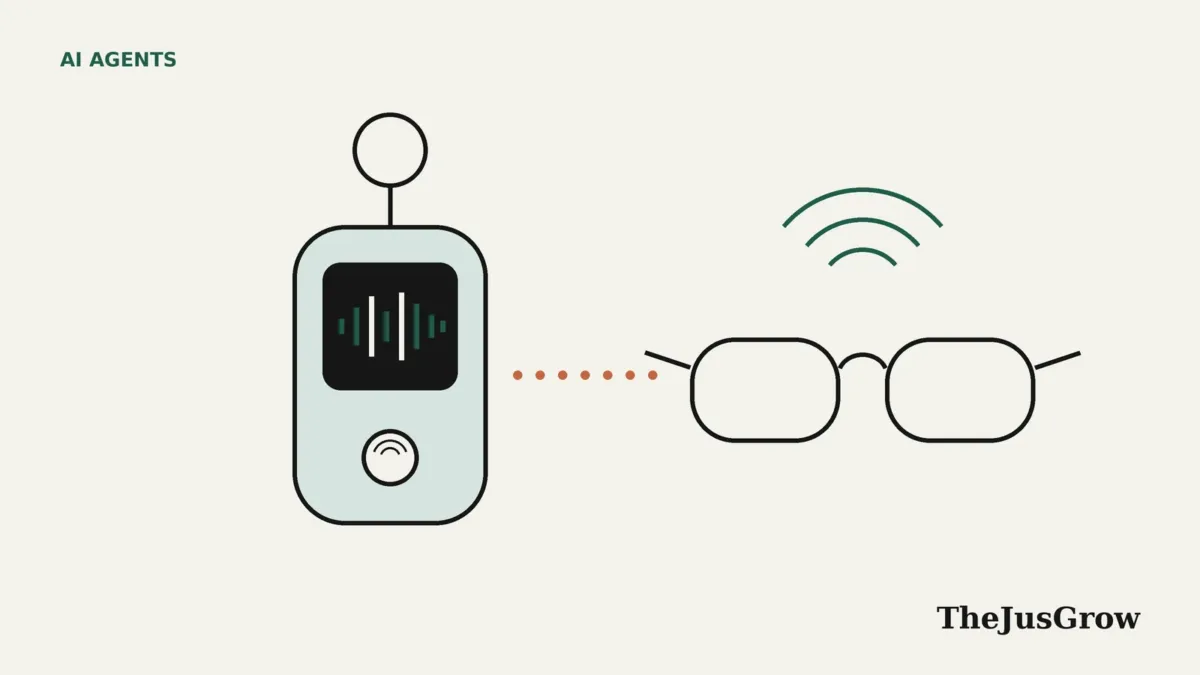
At Connect on 24 September 2026, Meta announced Muse Charm, a pocket-sized device for talking to its Muse AI agent, due “by December” according to Mark Zuckerberg, with no price yet. Meta also said Muse is coming to its AI glasses “in the coming months”, activated by saying your agent’s name and able to act on what you are looking at. Both extend an agent that can shop and send messages onto devices you carry all day.
Meta launched Muse, its personal AI agent, on 8 September as an app. Two weeks later, at its annual Connect event, it set out where Muse goes next: into your pocket and onto your face. The announcements were light on detail in places, so this article separates what Meta has confirmed from what has only been reported, based on Meta’s own Connect round-up and reporting from Bloomberg and others. TheJusGrow has not seen or used either product. For background on Muse itself, see our Muse explainer.
What is Muse Charm?
In Meta’s words, Muse Charm is “a delightful and fun device built for you to talk and interact with your Muse”. It combines Muse with Meta’s real-time voice model in something that fits in your pocket. Meta’s official post says only that it will “have more to share later this year”.
Reporting from the event adds more. According to Bloomberg, published by The Irish Times, the palm-sized device has:
- a 2-inch OLED touchscreen
- a 5G modem, so it doesn’t depend on your phone for a connection
- front and rear cameras
- a fingerprint sensor, speakers and microphones
- USB-C charging and support for music and video playback
Bloomberg says it can be worn on a wrist strap, carried in a pocket or hung from a lanyard, and compares its look to a 1990s Tamagotchi digital pet. Shacknews quotes Zuckerberg saying Meta “packed the whole Muse experience, including the whole real-time voice and avatar stack into something that fits on a keychain”.
When is it coming, and what will it cost?
Zuckerberg said the device will launch “by December” for the holiday season, according to Bloomberg. Meta has not announced a price. Bloomberg reports that executives indicated it would sit in the price range of a smartwatch, and that any cellular carrier fees have not been decided.
Treat all of that as provisional. Meta’s own post gives no date or price, and first-generation devices often change between announcement and launch.
Who designed it?
Bloomberg reports that the project was led by Alan Dye, Apple’s former head of interface design, and his deputy Billy Sorrentino, after Meta recruited them in late 2025. Meta’s chief technology officer Andrew Bosworth described it to Bloomberg as “cool”, “fun” and “different”, adding: “There’s nothing like it.”
Will a dedicated AI gadget work this time?
Standalone AI devices have a mixed record. Shacknews points to the Humane AI Pin, whose service was discontinued in February 2025. Meta seems aware of the risk: Bloomberg reports that Meta expects more people to use Muse through phones and smart glasses than through the Charm.
The difference Meta is betting on is the agent behind the device. A gadget that can only answer questions is easy to replace with a phone. One connected to an agent that can book, buy and message on your behalf may earn a place in a pocket, if the agent itself proves reliable. That remains to be seen.
How will Muse work on AI glasses?
This part of the announcement comes straight from Meta. In the coming months, Meta says, it will bring Muse to its AI glasses for hands-free access, “activated by saying your agent’s name”.
Meta says Muse will be able to act on what you are looking at, so you won’t have to describe it. Its examples: ask about a product on a shelf, a flier on a wall, or a long list of school supplies, and Muse can take action. Meta also announced a wider range of glasses at Connect, including its first audio-only Ray-Ban Meta Audio glasses and a new generation of Ray-Ban Meta glasses. Meta hasn’t said which models will support Muse first.
The other Connect announcements for Muse
Meta’s Connect round-up listed several other changes:
| Feature | What Meta says |
|---|---|
| Voice mode | Long conversations while Muse works in the background; you can describe the voice you want |
| Muse Realtime Avatar | An expressive, interactive avatar for your Muse |
| Email address | Muse gets its own address to get things done, or for you to message it |
| Mac computer use | With permission, Muse can drive any app on your Mac |
| More connectors | New retail partners including Walmart, Best Buy and Sephora, plus Notion, GitHub and Box |
Our separate article covers Muse for Mac in more detail.
What about privacy?
An agent on glasses or a device with cameras raises questions the phone app does not. Glasses that act on “what you’re looking at” have to see it first, which can include other people and private spaces. Meta’s Connect post doesn’t explain how visual data from glasses will be handled by Muse.
The same Muse rules should apply wherever you reach it: Meta says Muse doesn’t share conversations or its data with Meta’s ad systems, asks before important actions such as purchases, and lets you switch off AI training in its Data controls. It is worth checking these once the devices ship. Our checklist of Muse privacy settings is a good starting point, and our guide to whether AI agents are safe covers the wider risks.
The bottom line
Muse Charm and Muse on glasses show where Meta wants its agent to live: everywhere, not just in an app. Neither is available yet, Charm has no price, and key details, including how voice purchases and camera data are handled, are still to come. It is reasonable to be interested and still wait for full specifications and independent reviews before buying.
Key takeaways
- Meta announced Muse Charm, a pocket-sized device for talking to its Muse agent, at Connect on 24 September 2026.
- Bloomberg reports a 2-inch OLED screen, 5G, cameras and a fingerprint sensor, with launch “by December” and no price yet.
- Muse is coming to Meta’s AI glasses “in the coming months”, activated by name and able to act on what you are looking at.
- Meta also announced voice mode, avatars, an email address for Muse and Mac computer use.
- How camera and voice data from the new devices will be handled has not been fully explained; wait for details before buying.
Muse Charm: FAQs
Mark Zuckerberg said it is due by December 2026. Meta has not announced a price yet.
Bloomberg reports a 2-inch OLED screen, 5G, cameras and a fingerprint sensor. Meta has not published full specifications.
It is sensible to. Meta has not fully explained how camera and voice data from the new devices will be handled, so wait for details and early reviews.
Sources
- Meta, “Everything We Announced at Meta Connect 2026” (24 September 2026)
- Bloomberg via The Irish Times, “‘There’s nothing like it’: Meta unveils dedicated ‘Charm’ device for using Muse AI” (24 September 2026)
- Shacknews, “Muse Charm device for the AI agent revealed at Meta Connect 2026” (September 2026)
- Meta Newsroom, “Introducing Muse: The World’s First Personal AI Agent Built for Everyone” (8 September 2026)
- Meta Help Centre, “How Muse handles your privacy, safety and security” (accessed September 2026)