The Future of AI Agents: What Consumers Could Actually See Next
A clear-eyed look ahead that separates what already exists, what companies have formally announced, what seems likely, and what is still speculation.

The future of AI agents: the short answer
In the near term, consumers are most likely to see AI agents that shop and book within specific partner networks (Google has announced a Universal Cart and agent-payment standards; hotel booking is already rolling out in its AI Mode), run more tasks in the background on a schedule, and work across devices by voice. Longer-term ideas (agents negotiating with other agents, or replacing apps altogether) remain speculation.
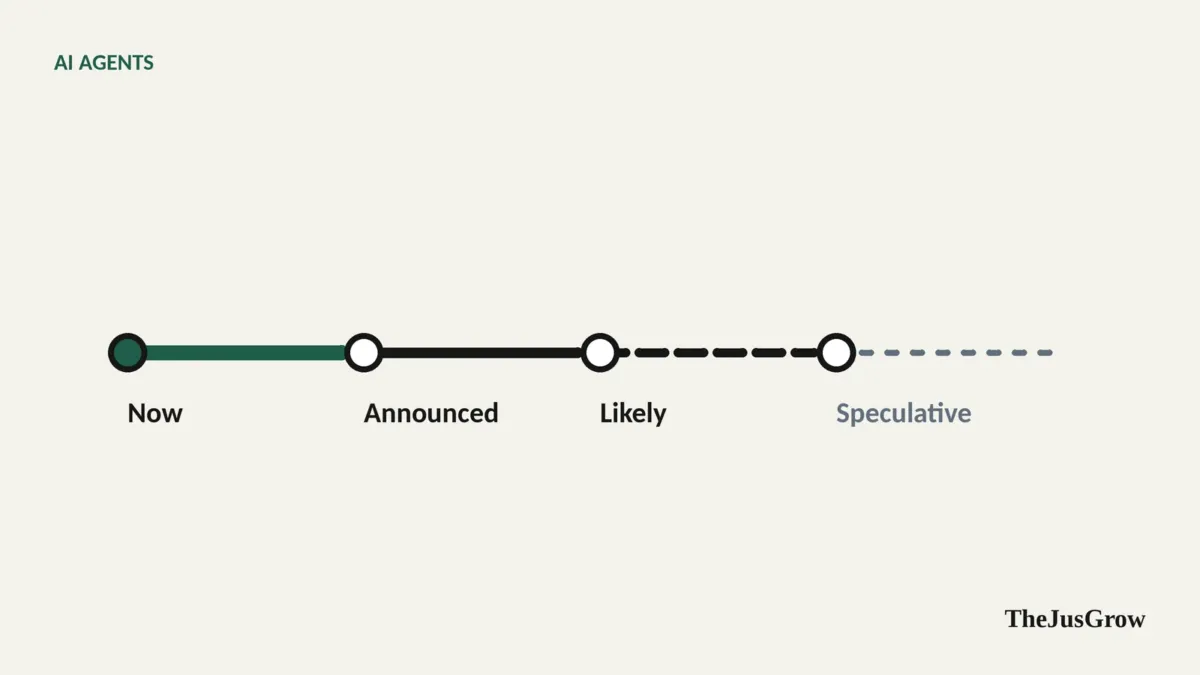
Predictions about AI tend to age badly because they blur the line between what exists and what someone hopes will exist. This piece keeps four categories strictly apart:
- Available now, shipped and documented.
- Announced, formally announced by a company, with or without a date.
- Reasonable expectations, our editorial judgement based on current direction. Not facts.
- Speculation, possible, widely discussed, unproven.
All dates are as of September 2026.
1. Available now
These exist today, though often limited by plan, region or merchant:
- General-purpose agents that research, produce documents and run scheduled tasks: ChatGPT Work, Claude’s task mode, Perplexity Computer and Gemini Spark (paid plans; Spark is unavailable in the EEA, UK, Switzerland and Nigeria).
- Supervised browser agents, such as Microsoft’s Browse with Copilot in Edge (rolling out to Microsoft 365 Premium subscribers in the US).
- Delegated checkout on merchants’ own sites in the US: Google’s agentic checkout for eligible merchants, and Amazon’s Buy for Me within Alexa for Shopping.
- Hotel booking inside Google’s AI Mode in the US, which began rolling out in August 2026 with partners such as Booking.com, Expedia, Marriott and Hilton.
- Shared connection standards, notably the Model Context Protocol, now governed by the Linux Foundation’s Agentic AI Foundation.
For what these do in practice, see the best AI agents for everyday tasks.
2. Announced
Formally announced by companies, but not necessarily available to you yet:
Google’s Universal Cart. Announced at Google I/O in May 2026: a shopping cart that works across merchants and Google services, tracks price history and stock, flags incompatible items, and supports checkout via Google Pay with participating brands, with “the brand” remaining the merchant of record. Google said it would launch in Search and the Gemini app in the US in summer 2026, with YouTube and Gmail later in 2026.
Agent payments with spending limits. Google said its Agent Payments Protocol (AP2), designed to create a verifiable link between the user, the merchant and the payment processor, with strict spending limits and brand restrictions, would begin rolling out in its products starting with Gemini Spark.
Wider international commerce. Google also said checkout experiences built on its Universal Commerce Protocol would expand to Canada, Australia and the UK “in coming months”.
Flight booking in AI Mode. Google has said its goal is to let people book flights as well as hotels directly in AI Mode; as of its August 2026 hotel announcement, flights still handed off to partners.
Gemini Spark on the desktop. Google announced Spark support for its macOS Gemini app, including working with local files, with rollout planned after the initial launch.
Announcements are not guarantees. Features slip, change scope or launch in fewer countries than first suggested. The best habit is to check the company’s help pages, not its keynote.
3. Reasonable expectations (editorial judgement)
Based on the direction of the products above, we think the following are likely over the next year or two. These are our views, not facts:
More merchants will support agent checkout, slowly. The standards (ACP, UCP, AP2) and card-network programmes exist; the bottleneck is retailers deciding it’s in their interest. Expect steady growth in big retailers and platform-hosted stores, and continued resistance from marketplaces worried about losing the customer relationship.
Confirmation will get smarter, not disappear. Every major provider documents human confirmation for purchases and messages. Rather than removing it, expect pre-approved limits (“up to $50 at these stores”) of the kind AP2 describes.
Background agents will become normal. Scheduled and event-triggered tasks already exist across ChatGPT, Gemini and Claude. Expect more of them to be offered as templates (“weekly bills check”, “school email digest”) so people don’t have to write instructions.
Voice will become a common way to start tasks. OpenAI already documents voice for its Work mode, and Amazon and Google are rebuilding voice assistants on language models. Starting a task by voice and reviewing it on a screen seems a natural pattern.
Security will become a selling point. As agents gain access, providers will compete on protection against prompt injection, clearer permission controls and audit logs. We’d expect independent testing of agent security to become more common.
Regulation will add obligations gradually. Rules such as the EU AI Act are phasing in over several years, with some timelines under active political discussion; consumer-protection and data-protection authorities are also paying attention. The practical effect for consumers is likely to be more disclosure and some features arriving later in some regions.
4. Speculation
These ideas are widely discussed but unproven. We include them so you can recognise them, not because we think they’re imminent:
- Agents negotiating with agents. Your agent haggling with a shop’s agent over price or delivery. Technically plausible; commercially and legally complicated.
- “Apps” fading behind agents. The idea that you’ll rarely open individual apps because your agent uses them for you. Some of this is happening at the margins; wholesale replacement is a long way off, and businesses have strong reasons to keep direct customer relationships.
- A single personal agent that knows everything. One trusted agent managing your whole digital life across companies. It runs into competition between companies, privacy law, and the security problem of putting everything behind one door.
- Fully autonomous errands in the physical world. Agents coordinating deliveries, repairs and appointments end-to-end without your involvement. Parts exist; reliable end-to-end autonomy doesn’t.
What to watch in the future of AI agents
If you want to judge whether the agent future is arriving, ignore demos and watch for:
- Merchant lists growing on Google’s and Amazon’s agent-checkout pages.
- Regional availability expanding beyond the US.
- Default confirmations and spending limits becoming standard settings.
- Independent security testing of agents’ resistance to manipulation.
- Stability, features that stay named and working for more than a year.
The last one may be the best signal of all. A technology is mature when it stops being renamed.
Key takeaways
- Today: research-and-document agents, supervised browser agents, and limited US delegated checkout and hotel booking.
- Announced: Google’s Universal Cart, agent payments with spending limits, wider UCP checkout, flights in AI Mode (goal).
- Likely: more merchants, smarter limits instead of fewer confirmations, background tasks and voice becoming normal.
- Speculative: agent-to-agent negotiation, apps disappearing, one all-knowing personal agent.
Future of AI agents: FAQs
Not any time soon. Agents are getting better at using apps for you, but the idea of apps disappearing altogether is still speculation.
Delegated shopping and booking inside partner networks. Google has announced Universal Cart and agent payment standards with spending limits, and hotel booking is already rolling out in its AI Mode in the US.
It is possible, but for now it remains speculation. The practical near-term change is agents running more tasks in the background on a schedule and working across devices by voice.
Sources
- Google, “Google Shopping introduces Universal Cart, agentic shopping” (May 2026)
- Google, “100 things we announced at Google I/O 2026”
- Google, “The Gemini app becomes more agentic, delivering proactive, 24/7 help” (May 2026)
- TechCrunch, Google AI Mode hotel booking (27 August 2026)
- Google, “Explore new ways to plan and book travel with AI in Search”
- DataCamp, “Gemini Spark: Google’s Always-On AI Agent Explained” (May 2026), on the macOS app plans
- Linux Foundation, Agentic AI Foundation announcement
- OpenAI Help Center, “ChatGPT Work and Codex” (voice with Work)