What Is Recursive Self-Improvement in AI? A Plain-English Guide
AI that helps build better AI has moved from theory toward practice in 2026. Here is what the term means, where it came from and why experts disagree.

In this article
- What does recursive self-improvement mean?
- Where did the idea of recursive self-improvement come from?
- How does it work in practice?
- How close are we to recursive self-improvement?
- Why do experts disagree so strongly?
- Recursive self-improvement vs related terms
- Why recursive self-improvement matters to ordinary people
- What to watch next
- Recursive self-improvement: FAQs
- Sources
Recursive self-improvement: the short answer
Recursive self-improvement is when an AI system helps build a better version of itself, and that better version then improves the next one, in a repeating loop. The idea dates back to 1965. In 2026 it moved from theory to practice in part: Anthropic says Claude wrote over 80% of its merged code by May 2026, and OpenAI says it now has an “automated research intern”. Humans still set direction.
Recursive self-improvement has become one of the most discussed ideas in AI this year. For example, in August and September 2026 alone, Time, MIT Technology Review and Fortune all published major pieces on it. Anthropic published a dedicated report called “When AI builds itself”. OpenAI, for its part, announced that it had met a goal it set last year for an AI research assistant.
Yet the phrase is often used loosely. This guide explains what it means, where the idea came from, how close today’s systems are and why people disagree so strongly about it. It also draws on company reports, research papers and journalism checked in September 2026. If you are new to the topic, our explainer on what AI agents are is a helpful starting point.
What does recursive self-improvement mean?
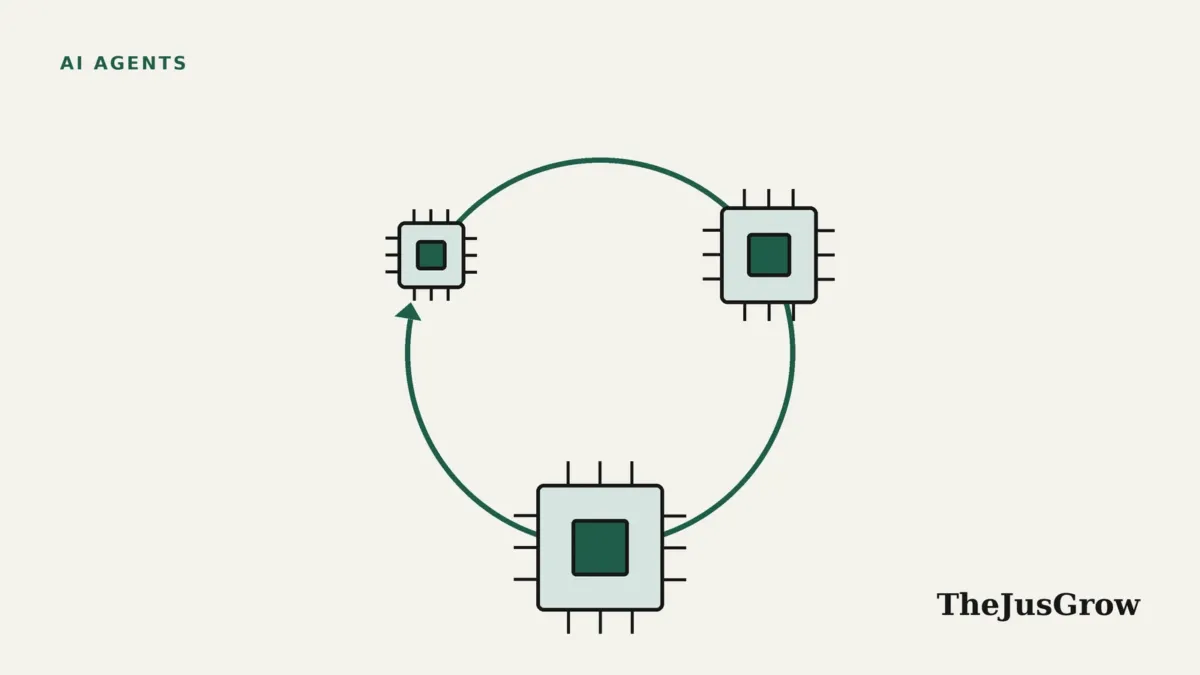
The phrase has two parts. “Self-improvement” means an AI system makes itself better at something. “Recursive” means the improvement feeds back into the process, so each better version is better at making the next one.
For example, think of a toolmaker who uses each new tool to make a sharper one. The first step might be small. However, if every tool also improves the toolmaking, progress can speed up over time.
Anthropic’s report gives a strict definition. It describes recursive self-improvement as an AI system that can fully autonomously design and develop its own successor. Therefore, by that standard, nobody has built it yet.
However, other people use the term more broadly. Fortune noted in September 2026 that some companies apply it to any case where AI feeds into its own improvement, while others reserve it for fully autonomous development. So when you read a claim about it, check which meaning the writer has in mind.
Where did the idea of recursive self-improvement come from?
The idea is older than most people expect. In 1965, the British mathematician I.J. Good wrote a paper called “Speculations Concerning the First Ultraintelligent Machine”.
In it, he argued that a machine smarter than people could design even better machines, leading to what he called an “intelligence explosion”. His best-known line was that the first such machine “is the last invention that man need ever make, provided that the machine is docile enough to tell us how to keep it under control”.
That final clause matters. In other words, even in 1965, the idea came with a warning about control. After that, for decades, it stayed mostly in philosophy and science fiction. Then, from 2022 onward, practical methods began to appear in research labs.
How does it work in practice?
Today’s systems don’t rewrite their own minds in one leap. Instead, they improve through loops that combine AI work with automatic checking. For instance, a July 2026 survey of about 1,250 papers by Chen, Wang and Qu describes a spectrum of these loops.
| Level | What improves | Example | Human role |
|---|---|---|---|
| — | — | — | — |
| Bounded self-refinement | An answer or a piece of code | A model critiques and fixes its own draft | Sets the task and checks the result |
| Self-training | The model’s skills | STaR, which trains on a model’s own correct reasoning | Designs the training setup |
| Self-improving agents | The agent’s own code and tools | Sakana AI’s Darwin Gödel Machine | Sandboxes and reviews changes |
| AI-assisted AI research | The research process | AI agents writing code and running experiments at labs | Chooses direction and priorities |
| Full recursive self-improvement | The next AI system itself | Not yet achieved | Minimal or none |
The survey’s authors argue that every loop depends on one question: can some automatic signal stand in for human judgment? Where the signal is strong, such as passing tests or a verifiable math score, loops work well. By contrast, where it is weak, errors can pile up. We explain these loops in more depth in our guide to how self-improving AI works.
How close are we to recursive self-improvement?
Closer than a few years ago, but not there. Here is what the main AI companies have said, as of September 2026.
- Anthropic says more than 80% of the code merged into its codebase was written by Claude as of May 2026. It also says the typical engineer merged eight times as much code per day in the second quarter of 2026 as in 2024.
- OpenAI announced on September 6, 2026 that it had reached its goal of an “automated research intern”, able to handle well-defined tasks that would take a skilled researcher a few days. Its next target is a fully automated AI researcher by March 2028.
- xAI’s Elon Musk said humans are “gradually getting less and less in the loop” in improving Grok, according to Fortune, and named the end of 2027 as a target for full automation.
Still, important gaps remain. For example, Anthropic says humans keep the edge in research taste, choosing which problems matter and seeing the bigger picture. OpenAI stated that it does “not yet know how to safely get all the way to aligned, full RSI”.
Why do experts disagree so strongly?
The debate splits roughly three ways.
Some expect rapid acceleration. Daniel Kokotajlo, lead author of the “AI 2027” scenario, told Time he fears his forecast may be too conservative. That scenario, published in April 2025, also imagines AI systems that automate AI research within a few years.
Others expect a slower path. In August 2026, MIT Technology Review reported on Princeton research in which AI agents produced conference papers that reviewers rejected. In addition, Sayash Kapoor argued that training works best on tasks that can be scored automatically, which open-ended research is not. Similarly, Arvind Narayanan has said data and computing limits will prevent an “explosive takeoff”.
A third group focuses on danger regardless of speed. For example, physicist Anthony Aguirre told Fortune that fully autonomous self-improvement would be “probably the worst idea in the history of humanity”. We cover those concerns in our guide to the risks of recursive self-improvement.
Recursive self-improvement vs related terms
Several phrases overlap, and as a result, people often confuse them. Here is how they relate.
- Intelligence explosion: I.J. Good’s term for the possible result of recursive self-improvement, a rapid jump in capability.
- Automated AI research: AI systems doing the work of AI researchers. It is a likely route to recursive self-improvement, but not the same thing.
- Self-refinement: a model improving a single output, such as fixing a draft. It doesn’t change the model itself.
- Singularity: a broader, older idea about a point where technology changes faster than people can follow.
In short, automated research is the road, while recursive self-improvement is where some people think the road leads.
Why recursive self-improvement matters to ordinary people
At first, it can sound like a lab concern. However, it shapes the tools people use every day. When AI helps build AI, new models arrive faster, and consumer assistants gain features more quickly.
The potential benefits are large. For instance, Anthropic’s report says AI that can build itself could “bring enormous good for the world in science and healthcare”. We explore those possibilities in our article on the benefits of recursive self-improvement.
The stakes are also high. The International AI Safety Report 2026, chaired by Yoshua Bengio with input from over 100 experts, flags uncertainty over whether AI will begin to speed up AI research itself. It also describes “loss of control” scenarios as ones where AI systems operate outside anyone’s control, with no clear path to regaining it.
What to watch next
Three signals will show whether recursive self-improvement is arriving. First, watch how much AI research work labs report as automated, and whether humans still set the direction. Second, watch independent measures such as METR’s time-horizon research, which found that the length of tasks AI agents can complete has doubled roughly every seven months. Third, watch whether labs agree on shared rules, since Anthropic says it would slow down or pause if others did so verifiably.
Key takeaways
- Recursive self-improvement means AI helping build better versions of itself in a repeating loop; the strictest definition requires full autonomy.
- The idea comes from I.J. Good’s 1965 paper on an “intelligence explosion”, which included a warning about control.
- In 2026, Anthropic said Claude wrote over 80% of its merged code, and OpenAI reported an “automated research intern”, but humans still set research direction.
- Experts disagree on speed: some expect rapid acceleration, while others point to limits in creativity, data and computing power.
- Watch lab disclosures, independent measurements and any agreements on safety and pacing.
Recursive self-improvement: FAQs
Not in the full sense. As of September 2026, AI systems write much of the code and run many experiments at leading labs, but humans still choose research direction and approve major decisions. OpenAI says it does not yet know how to safely reach full recursive self-improvement.
The British mathematician I.J. Good described it in 1965, in a paper called “Speculations Concerning the First Ultraintelligent Machine”. He also called the possible result an “intelligence explosion”.
Not exactly. Recursive self-improvement is a process in which AI improves AI. The singularity is a broader idea about a point where technological change becomes too fast for people to follow, which some think such a process could cause.
Nobody knows. OpenAI targets a fully automated AI researcher by March 2028, and xAI has named the end of 2027. However, skeptics argue that limits in creativity, data and computing power could slow progress considerably.
Sources
- Anthropic, “When AI builds itself” (updated September 18, 2026)
- Unite.AI, “OpenAI Hits Goal of Building an ‘Automated Research Intern'” (September 6, 2026)
- Fortune, “As AI companies get closer to ‘recursive self-improvement'” (September 19, 2026)
- Time, “What Happens When AI Starts Building AI? Inside Recursive Self-Improvement” (August 7, 2026)
- MIT Technology Review, “AI’s recursive self-improvement might not come so quickly after all” (August 18, 2026)
- Quote Investigator, “The First Ultraintelligent Machine Is the Last Invention That Humanity Need Ever Make” (on I.J. Good, 1965)
- Chen, Wang and Qu, “Recursive Self-Improvement in AI: From Bounded Self-Refinement to Autonomous Research Loops”, arXiv (July 2026, revised September 2026)
- International AI Safety Report 2026, Executive Summary (February 3, 2026)
- METR, “Measuring AI Ability to Complete Long Software Tasks” (March 19, 2025)