AI Agents for Students: What They Can and Can’t Do
Used well, an AI agent is a tireless study organiser and research assistant. Used badly, it's an academic-misconduct case waiting to happen. Here's where the line sits.

AI agents for students: the short answer
AI agents can help students plan revision, gather and organise sources, explain difficult ideas, generate practice questions, track deadlines and tidy notes. They should not be used to produce work you submit as your own, take quizzes or exams, or invent citations, which they sometimes do by accident. Your institution’s AI policy is the rule that counts: check it for each course, and disclose AI use when it’s required.
Students were among the first mass users of AI chatbots, and much of the public debate has been about cheating. That debate matters, but it misses something: agents are genuinely good at the organisational side of studying, the planning, collecting and tracking that eats hours without teaching you anything.
The simplest way to stay on the right side of the line: use AI to help you learn and organise, not to do the thinking you’re being assessed on.
A traffic-light guide
Policies vary (some courses ban AI entirely, others encourage it with disclosure) so treat this as a starting point, not a ruling.
| Green: generally fine | Amber: check your course policy | Red: don’t |
|---|---|---|
| Building a revision timetable from your syllabus | Getting feedback on your draft’s structure or clarity | Submitting AI-written essays, reports or code as your own |
| Explaining a concept you’re stuck on, in different ways | Having AI suggest sources you then read yourself | Letting an agent complete online quizzes, tests or exams |
| Generating practice questions and quizzing you | Summarising readings (as a supplement, not a replacement) | Asking AI to “paraphrase” someone else’s work to avoid detection |
| Tracking deadlines from course emails and portals | Translation help for non-native speakers | Inventing or accepting citations you haven’t checked |
| Organising and tagging your own notes | Checking grammar and spelling in assessed work | Using AI where your instructor has explicitly banned it |
| Formatting a bibliography from sources you’ve read | Brainstorming topics or research questions | Uploading others’ private data or unpublished work |
What AI agents are genuinely good at for studying
Planning and deadlines
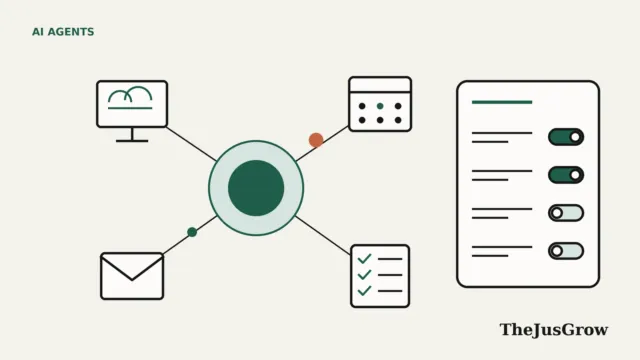
This is the most underrated use. An agent with access to your calendar and course emails can build a realistic revision plan and keep it updated.
Here’s my exam timetable and the topics for each paper. I can study about 3 hours on weekdays and 5 on weekends. Build a revision plan that covers every topic at least twice, puts harder topics earlier, and leaves the day before each exam light. Add the sessions to my calendar.
Every Sunday, check my university email for new assignment deadlines or changes, and list them with due dates and links.
Explaining things you don’t understand
Ask for multiple explanations (an analogy, a worked example, a step-by-step breakdown) then explain the idea back in your own words and ask the AI to point out what you got wrong. That last step is where learning happens.
Practice and self-testing
Research on learning consistently finds that testing yourself is one of the most effective ways to remember material. AI makes this easy:
Using my lecture notes (attached), give me 10 exam-style questions on topic 3, one at a time. Wait for my answer, then tell me what I missed.
Research legwork
An agent can search databases and websites, collect potentially relevant sources, and organise them into a reading list with summaries. You still need to read the sources. An agent’s summary is a map, not the territory, and a summary can’t be cited.
Tidying notes and files
Agents with access to folders you choose can rename lecture files consistently, merge notes by topic, and turn a messy document into a structured study guide. Keep a backup before you let any tool reorganise your files.
What AI agents can’t (or shouldn’t) do for you
Write your assessed work
Beyond the integrity issue, it’s a bad trade: you pay tuition to build skills, and outsourcing the work skips the part that builds them. Detection tools are unreliable in both directions, but instructors often spot AI work anyway, it tends to be generic, and it can’t be defended in conversation.
Take tests
Letting an agent sit a quiz or exam, even a low-stakes online one, is misconduct almost everywhere. Some AI providers also restrict their agents from doing this.
Guarantee accurate citations
Language models can produce references that look real but don’t exist, or attribute real papers to the wrong authors or claims. Every citation you use must be one you’ve found and checked yourself. If an agent suggests a source, open it before you trust it.
Know your institution’s rules
An agent can’t tell you whether your specific course allows AI use. Your syllabus, instructor or academic-integrity office can.
Privacy and age limits
Student accounts and personal accounts have different rules. Some AI features are restricted by age, Google, for example, requires users to be 18 or over and to use a personal (not school) account for Gemini Spark, and school or university accounts may have AI features limited or disabled by administrators. Don’t upload classmates’ work, private feedback or personal information about others into AI tools without permission.
A sensible study setup
- Read your institution’s and each course’s AI policy. Save the relevant lines in your notes.
- Use AI for organisation first: timetable, deadlines, file tidying.
- Use it as a tutor, not a ghostwriter: explanations and practice questions.
- Keep a simple log of how you used AI on assessed work, in case you need to disclose it.
- Verify every fact and source that ends up in anything you submit.
The students who get the most out of AI agents are the ones who use them to spend more time actually studying, not less.
Key takeaways
- Use agents for planning, deadlines, explanations, practice questions and research legwork.
- Don’t submit AI-written work, let agents take tests, or rely on citations you haven’t checked.
- Course policies differ, check each one and disclose AI use where required.
- Test yourself with AI-generated questions; it’s one of the most effective uses.
- Mind privacy and age limits, especially with school accounts and others’ data.
AI agents for students: FAQs
It depends on your course policy and how you use it. Planning, explanations and practice questions are usually fine. Submitting AI-written work as your own, or letting an agent take a quiz, is not. Check each course and disclose AI use where required.
Self-testing is one of the most effective. Ask for practice questions on a topic and answer them without notes. Agents are also good at building revision timetables, tracking deadlines and gathering sources to read.
Yes, AI tools sometimes invent sources that look real. Open every citation and confirm the author, title and year before you use it.