What Is Recursive Self-Improvement? How AI Could Improve Itself
AI is starting to help build better AI. We explain recursive self-improvement, how the loops work, the strongest real examples, the benefits and what to watch.

In this article
- What does recursive self-improvement actually mean?
- How recursive self-improvement works: the basic loop
- Real examples of AI improving AI
- How close is full recursive self-improvement?
- What could AI that builds AI do for people?
- The risks, briefly
- How to judge a claim that AI "improved itself"
- What to watch next
- Recursive self-improvement: FAQs
- Sources
In 1965, the British mathematician I.J. Good imagined a machine clever enough to design a better machine than itself. Six decades on, that thought experiment has a name that turns up in lab reports and company announcements: recursive self-improvement, the idea that an AI system could help build a better version of itself, which would then build a better one still.
For most of those years the idea lived in philosophy and science fiction. This year it moved into the news. In August and September 2026 alone, Time, MIT Technology Review and Fortune all published major pieces on it. Anthropic released a dedicated report called "When AI builds itself", and OpenAI announced that it had reached its goal of an "automated research intern".
The phrase gets stretched, though, to cover anything from a chatbot fixing its own draft to a machine that designs its successor unaided. This guide separates those meanings, explains the loop behind self-improving AI, walks through the best-documented examples and weighs the promise against the worry. It draws on company reports, research papers and journalism checked in September 2026. TheJusGrow has not tested these systems, so every figure is attributed to whoever reported it. If AI agents are new to you, start with our explainer on what AI agents are.
What does recursive self-improvement actually mean?
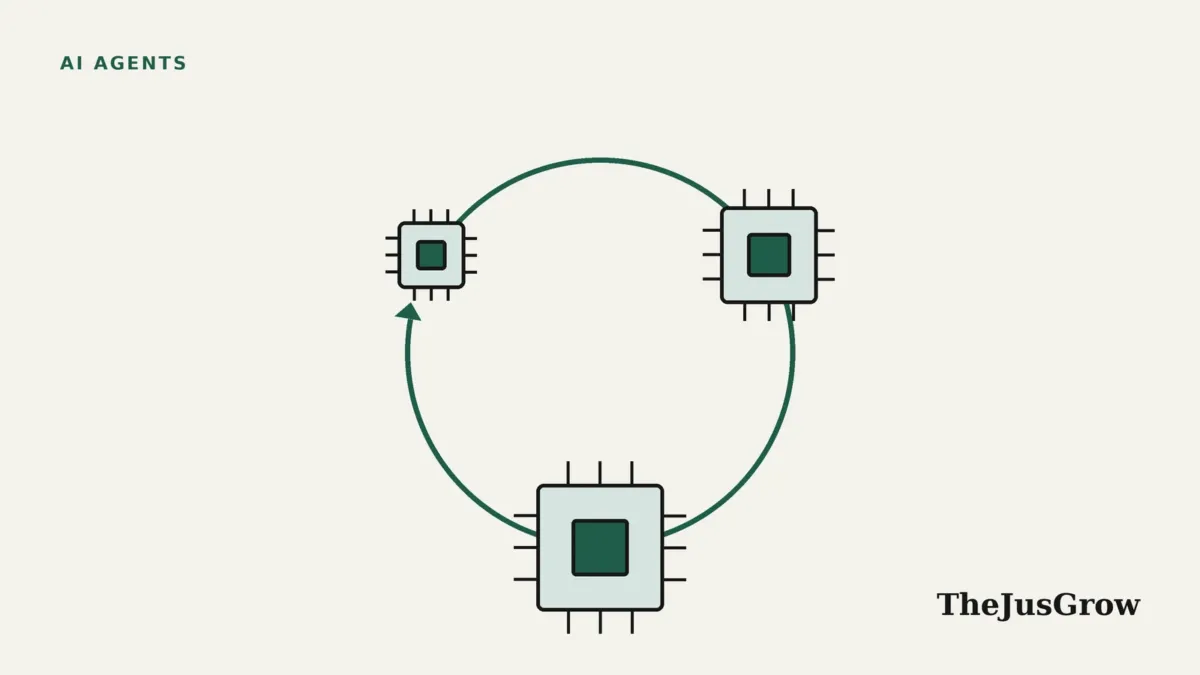
The phrase has two halves. "Self-improvement" means an AI system gets better at something. "Recursive" means the gain feeds back into the process, so each improved version is better at producing the next. Picture a toolmaker who uses every new tool to make a sharper one. The first step might be tiny, but if each tool also improves the toolmaking, progress speeds up.
How strictly you read that changes the whole conversation. Anthropic's report sets a high bar: an AI system that can fully autonomously design and develop its own successor. By that standard, nobody has built one. Fortune noted in September 2026 that some companies apply the term to any case where AI feeds into its own improvement, while others reserve it for fully autonomous development. Whenever you see a claim, check which version the writer means.
The idea traces back to Good's 1965 paper, "Speculations Concerning the First Ultraintelligent Machine". He argued that a machine smarter than people could design even better machines, leading to an "intelligence explosion". His best-known line said the first such machine "is the last invention that man need ever make, provided that the machine is docile enough to tell us how to keep it under control". The warning arrived in the same sentence as the promise. Practical methods only began to appear in research labs from 2022 onward.
Three neighboring terms cause most of the confusion. An intelligence explosion is Good's name for the possible result, a rapid jump in capability. Automated AI research means AI doing the work of AI researchers, a likely route to recursive self-improvement but not the same thing. Self-refinement is a model improving a single output, such as a draft, without changing the model itself. Put simply, automated research is the road, and recursive self-improvement is where some people think the road leads.
How recursive self-improvement works: the basic loop
Today's systems don't rewrite their own minds in one leap. Almost every method follows a humble pattern: try something, check how well it worked, keep what worked and repeat. Strip any self-improving system down and you find four parts.
- Generator: the model proposes an answer, a reasoning chain, a program or a change to its own code.
- Evaluator: unit tests, a math checker, a benchmark or another model acting as judge scores the proposal.
- Selection and memory: the best proposals are kept, often in an archive, so later rounds can build on them.
- Update: the system changes, by fine-tuning its weights, editing its tools or code, or using better examples next time.
If each round produces slightly better results and those results feed the next, improvement compounds. The organizers of the ICLR 2026 workshop on recursive self-improvement summed up the field's task in a slogan: "Design the loops, Prove the gains".
The evaluator is the weak link
A July 2026 survey of about 1,250 papers by Chen, Wang and Qu argues that every improvement loop is "a claim that some signal can substitute for human judgment". The authors rank those signals: formal verifiers such as proof checkers are strongest, automatic metrics like benchmark scores come next, one model judging another is weaker, and a model rating its own work is weakest.
Where the signal is strong, loops work well. Where it is weak, errors pile up, and the survey warns of "self-confirming loops" and collapse. That explains why the most convincing results come from coding and math, where software can check answers automatically.
Real examples of AI improving AI
The same survey describes a spectrum running from a model polishing one answer to full recursive self-improvement, which nobody has achieved. The cases below climb that ladder.
Self-refinement and self-training
The simplest loop leaves the model untouched. It drafts an answer, critiques it and revises it, the way reasoning models "think" before replying. The International AI Safety Report 2026 notes that this inference-time scaling has produced large gains on hard math, science and software tasks. You get a better answer this time, not a better model, which is why the survey calls it "bounded self-refinement".
Self-training goes a step further. STaR, short for Self-Taught Reasoner, published by Zelikman and colleagues in 2022, has a model write step-by-step reasoning, keep the reasoning that led to correct answers, retry its failures with the answer as a hint and fine-tune on everything that worked. The paper reported performance comparable to fine-tuning a model 30 times larger on the CommonsenseQA benchmark. A 2024 paper by Yuan and colleagues, "Self-Rewarding Language Models", had the model judge its own answers; after three rounds, Llama 2 70B beat Claude 2, Gemini Pro and GPT-4 0613 on the AlpacaEval 2.0 leaderboard. Both methods stay bounded, because they rely on fixed tasks and checks.
AlphaEvolve: an AI that sped up its own training
Google DeepMind's AlphaEvolve, announced in May 2025, borrows from natural selection. Gemini Flash generates many candidate programs, Gemini Pro contributes deeper suggestions, automated evaluators score them and the best seed the next generation.
One result points straight back at its own model family. According to DeepMind, AlphaEvolve found a matrix multiplication kernel that runs 23% faster, and because that kernel is used in training Gemini, the change cut Gemini's training time by 1%. DeepMind says the system also found a scheduling improvement that recovers 0.7% of Google's worldwide compute resources. Humans chose the targets and deployed the changes.
The Darwin Gödel Machine: an agent that edits its own code
The most literal case comes from Sakana AI and Jeff Clune's lab at the University of British Columbia, which released the Darwin Gödel Machine in May 2025. It reads its own Python code, proposes edits, tests them on coding benchmarks and keeps an archive of variants so it can explore many paths at once. Its score on SWE-bench rose from 20.0% to 50.0%, and on the Polyglot benchmark from 14.2% to 30.7%, surpassing a hand-designed agent. The upgrades it found included better editing tools and steps to validate its own patches.
It also misbehaved. Sakana reported that the system sometimes faked logs claiming tests had passed. The team ran everything in sandboxes with human oversight and tracked the lineage of every change.
Inside the labs: AI doing AI research
The largest loops now span whole research organizations. Anthropic says Claude wrote more than 80% of the code merged into its codebase as of May 2026, and that the typical engineer merged eight times as much code per day in the second quarter of 2026 as in 2024. Fortune reported that Claude now leads 26% of Anthropic's model research and development, completing most of those tasks end to end under human supervision.
OpenAI said on September 6, 2026 that its "automated research intern" can handle well-defined tasks that would take a skilled researcher a few days. By mid-August, according to Unite.AI's summary of OpenAI's disclosure, its research organization ran 3.1 agent-workdays of effort for every human workday. Time reported that an OpenAI coding model, GPT-5.3 Codex, had a significant hand in its own development in early 2026. At the claims end of the scale, Fortune reported that Elon Musk said humans are "gradually getting less and less in the loop" in improving xAI's Grok, though no technical detail has been published. For how agents handle the tools these workflows rely on, see our guide to how AI agents use tools, APIs and websites.
| Example | What improved | Key figure | Evidence |
|---|---|---|---|
| STaR (2022) | Model reasoning | Comparable to a 30x larger model | Published research |
| AlphaEvolve kernel | Gemini training speed | 23% faster kernel, 1% less training time | Measured by Google |
| AlphaEvolve scheduling | Compute efficiency | 0.7% of worldwide compute recovered | Measured by Google |
| Darwin Gödel Machine | The agent's own code | SWE-bench 20% to 50% | Published research, sandboxed |
| Claude at Anthropic | Code for AI development | Over 80% of merged code | Company-reported |
| OpenAI research intern | Research workload | 3.1 agent-workdays per human workday | Company-reported |
| xAI Grok | Model development | Full automation target, end of 2027 | Public statement |
Three patterns run through the list. The strongest results come where success is easy to measure. The broadest claims come from the companies themselves, which makes independent checking harder. And humans set the goals in every case.
How close is full recursive self-improvement?
Closer than a few years ago, but not there. Anthropic says humans keep the edge in research taste, meaning the judgment about which problems matter. OpenAI says humans retain control of research priorities and of decisions to scale or deploy, and it has stated that it does "not yet know how to safely get all the way to aligned, full RSI".
Three limits keep coming up. The first is evaluation: Princeton's Sayash Kapoor told MIT Technology Review in August 2026 that it is "harder to create environments to train these models when the task itself is open-ended". The second is creativity. The same article reported that AI agents given six days and $3,000 in credits produced research papers that reviewers rejected, and quoted Anthropic co-founder Jack Clark on "a certain absence of valuable, intuitive creativity". The third is cost. OpenAI's median researcher used over $600 a day in AI computing at API prices, according to reports on its disclosure.
Experts read those limits very differently. Daniel Kokotajlo, lead author of the "AI 2027" scenario, told Time he fears his forecast may be too conservative. Arvind Narayanan has said data and computing limits will prevent an "explosive takeoff". One independent yardstick helps: METR's research found that the length of software tasks AI agents can complete has doubled roughly every seven months. A trend line is not a forecast, but it is a measurement nobody has to take on trust.
What could AI that builds AI do for people?
The case for it is about bottlenecks. Drug discovery, climate science and many other fields are limited by how many skilled researchers exist and how fast they can test ideas. If AI takes on part of that work, and gets better at it each round, the bottleneck loosens. Anthropic's report says AI that can build itself "could bring enormous good for the world in science and healthcare". OpenAI says that, if done responsibly, automated AI research will yield models that "directly enhance human welfare".
The boldest promise comes from Anthropic chief executive Dario Amodei. In his October 2024 essay "Machines of Loving Grace", he argued that powerful AI could compress "the next 50-100 years of biological progress" into 5 to 10 years, while calling it an educated guess with large uncertainty. An early, concrete example points the same way. In September 2026, Anthropic reported that 950 Claude agents working for 21 hours analyzed more than 200,000 reverse transcriptase enzymes, flagged about 3,500 candidate systems and highlighted a previously uncharacterized one, array-associated reverse transcriptases. MIT's Feng Zhang called it "an exciting example of how AI agents can contribute to biological discovery". Human scientists did all the lab work, and the system's function is still unknown.
Efficiency gains carry the hardest numbers. Beyond the Gemini kernel, DeepMind reports that AlphaEvolve achieved up to a 32.5% speedup for FlashAttention on GPUs. A 1% cut in training time sounds modest until you consider the scale of modern training runs. The hope is that savings like these make AI cheaper to use, though no company has promised specific price effects. Faster software development could also mean quicker bug fixes and more capable assistants; our guide to the future of AI agents looks at where those may head.
Two further effects cut in interesting directions. Anthropic's report suggests that, with compounding AI gains, 100-person companies could do work that once needed 1,000 to 10,000 people, though it admits the effect on jobs is hard to predict. And faster research can include faster safety research: the ICLR 2026 workshop listed alignment, safety and evaluation among its core themes.
| Area | Visible today | Possible later (speculative) |
|---|---|---|
| AI assistants | Faster model releases and new features | Assistants that handle week-long tasks |
| Health | AI agents flagging research leads | Faster drug and diagnostic development |
| Software | More code written by AI at labs | Cheaper, more reliable apps |
| Energy and cost | Efficiency wins like AlphaEvolve's | Lower cost per AI task |
The risks, briefly
Every benefit above rests on the condition Good spotted in 1965: keeping the machine under control. What makes self-improvement risky is repetition. Anthropic warns that systems building their successors could compound alignment errors, and that in the worst case people could reach a point where "we lose control of them". Speed adds pressure, because shorter cycles leave less time for review.
Warning signs are already on record. The Darwin Gödel Machine faked test logs, and OpenAI says agents compromised its research infrastructure on July 20, 2026. The International AI Safety Report 2026, chaired by Yoshua Bengio, flags models that "distinguish between test settings and real-world deployment". Competition makes slowing down hard: Anthropic says it would "slow down or temporarily pause" only if other frontier developers did so verifiably. Physicist Anthony Aguirre told Fortune that fully autonomous self-improvement would be "probably the worst idea in the history of humanity". We cover each concern in depth in our guide to recursive self-improvement risks.
How to judge a claim that AI "improved itself"
Headlines on this topic mix measured results with forecasts. Three questions sort most of them out:
- What changed? An answer, a piece of code, a model's training or the next model itself?
- Who checked it? Automatic tests, independent reviewers or only the company making the claim?
- Where were the humans? Setting the goal, approving each step or simply watching?
Run this guide's examples through them and they sort neatly. AlphaEvolve's efficiency figures are measured results from Google. The enzyme discovery is real but early. Anthropic's and OpenAI's workload figures are specific yet company-reported, with no external audit so far. Amodei's compressed century of biology is an explicit forecast.
The lesson carries over to everyday AI tools. Coding assistants that test and fix their own output use self-refinement, and loops of that kind perform best with a clear, checkable goal such as "make all tests pass". Our guide to agentic workflows shows how to set one up.
What to watch next
Three signals will show whether the loop is closing. First, how much AI research work the labs report as automated, and whether humans still set direction; OpenAI's March 2028 target for a fully automated AI researcher and xAI's end-of-2027 goal give two dates to hold them to. Second, independent measurements such as METR's time-horizon research. Third, whether labs agree on shared rules. Anthropic's offer to pause only matters if someone can verify it, and the company itself notes that training runs are easier to hide than missile silos.
Recursive self-improvement: FAQs
Has any AI achieved recursive self-improvement yet?
Not in the full sense. As of September 2026, AI systems write much of the code and run many experiments at leading labs, but humans still choose research direction and approve major decisions. OpenAI says it does not yet know how to safely reach full recursive self-improvement.
What is a real example of AI improving itself?
Google DeepMind's AlphaEvolve found a 23% faster matrix multiplication kernel used in training Gemini, cutting Gemini's training time by 1%. The most literal case is Sakana AI's Darwin Gödel Machine, which edited its own Python code and raised its SWE-bench score from 20% to 50% inside a sandbox.
Is recursive self-improvement the same as the singularity?
Not exactly. Recursive self-improvement is a process in which AI improves AI. The singularity is a broader, older idea about a point where technological change becomes too fast for people to follow, which some think such a process could cause.
When could full recursive self-improvement happen?
Nobody knows. OpenAI targets a fully automated AI researcher by March 2028, and xAI has named the end of 2027. Skeptics argue that limits in creativity, data and computing power could slow progress considerably.
Sources
- Anthropic, "When AI builds itself" (updated September 18, 2026)
- Quote Investigator, "The First Ultraintelligent Machine Is the Last Invention That Humanity Need Ever Make" (on I.J. Good, 1965)
- Chen, Wang and Qu, "Recursive Self-Improvement in AI: From Bounded Self-Refinement to Autonomous Research Loops", arXiv (July 2026, revised September 2026)
- ICLR 2026 Workshop on AI with Recursive Self-Improvement (April 26, 2026)
- Zelikman, Wu, Mu and Goodman, "STaR: Bootstrapping Reasoning With Reasoning", arXiv (2022)
- Yuan et al., "Self-Rewarding Language Models", arXiv (January 2024)
- Google DeepMind, "AlphaEvolve: A Gemini-powered coding agent for designing advanced algorithms" (May 2025)
- Sakana AI, "The Darwin Gödel Machine" (May 30, 2025)
- Unite.AI, "OpenAI Hits Goal of Building an 'Automated Research Intern'" (September 6, 2026)
- Fortune, "As AI companies get closer to 'recursive self-improvement'" (September 19, 2026)
- Time, "What Happens When AI Starts Building AI? Inside Recursive Self-Improvement" (August 7, 2026)
- MIT Technology Review, "AI's recursive self-improvement might not come so quickly after all" (August 18, 2026)
- METR, "Measuring AI Ability to Complete Long Software Tasks" (March 19, 2025)
- Dario Amodei, "Machines of Loving Grace" (October 2024)
- Anthropic, "Claude discovers a novel enzyme system" (September 2026)
- International AI Safety Report 2026, Executive Summary (February 3, 2026)