Claude Haiku 5.5: What’s New, What It Costs and Who Should Use It
Anthropic's new small model costs about a tenth of its predecessor and adds a 1 million token context window. Here is what changed, where to use it and what to watch out for.

In this article
- The price cut is the point
- Is it actually good, or just cheap?
- Where Claude Haiku 5.5 fits in an agent
- What else changed in Claude Haiku 5.5
- A warning for developers upgrading from Haiku 4.5
- Safety: tighter than before, looser than the big models
- What it means if you don’t write code
- Still unanswered about Claude Haiku 5.5
- Claude Haiku 5.5: FAQs
- Sources
Claude Haiku 5.5 in brief
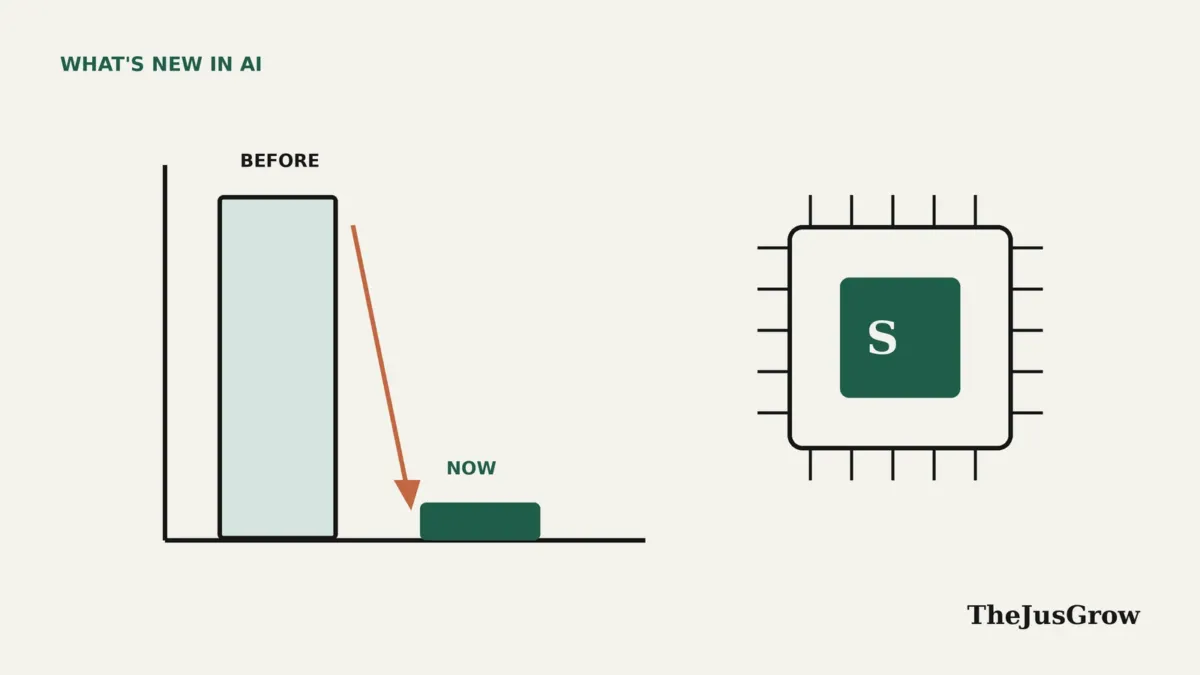
Claude Haiku 5.5 is Anthropic’s new small model, released on 7 October 2026. The headline is price: $0.10 per million input tokens and $0.50 per million output tokens for prompts under 100,000 tokens, roughly a tenth of what Haiku 4.5 cost. It also gets a 1 million token context window. Developers can use it now; Anthropic hasn’t said which Claude app plans include it.
Small models rarely get much attention. They don’t top leaderboards, and nobody writes breathless threads about them. But Claude Haiku 5.5 deserves a closer look, because small models are what most AI features actually run on. When your email app sorts a message, a support bot answers a question, or an agent clicks through a web page on your behalf, there’s a good chance a model in this class is doing the work.
So when Anthropic cuts the price of that tier by about 90% and claims a big jump in capability at the same time, it changes the economics of a lot of products you already use. That’s the real story here, more than any single benchmark.
What follows is based on Anthropic’s launch page and its platform release notes, both read in October 2026. The performance figures are Anthropic’s own. Nobody outside the company has published independent tests yet, and I’d treat them accordingly.
The price cut is the point
Anthropic charges per token, roughly a word fragment. For prompts up to 100,000 tokens, which Anthropic says covers about 90% of the requests people sent to Haiku 4.5, the new prices look like this:
| Per million tokens | Claude Haiku 5.5 (up to 100K) | Haiku 4.5 | Sonnet 5.5 |
|---|---|---|---|
| Input | $0.10 | $1.00 | $2.00 |
| Output | $0.50 | $5.00 | $10.00 |
| Cache reads | $0.01 | $0.10 | $0.10 |
Longer prompts cost five times more on the new model ($0.50 in, $2.50 out), which is still half of Haiku 4.5’s flat rate.
To see what that means in practice, take a modest job: summarising 1,000 customer emails, each around 2,000 tokens with instructions, producing 200-token summaries. That’s 2 million tokens in and 200,000 out. On Claude Haiku 5.5 the bill comes to about 30 cents. At Haiku 4.5 prices it was about $3.
Thirty cents versus three dollars doesn’t sound dramatic for one batch. It matters because agents don’t make one call. An agent researching a purchase or filing your expenses might make dozens or hundreds of model calls to finish a single task, and every one of them is now a tenth of the cost. Features that were too expensive to run in the background suddenly aren’t.
There’s one wrinkle worth knowing. Anthropic says the new model uses an updated tokenizer that produces slightly more tokens for the same text. Real savings will be a little below the headline figure, so anyone budgeting carefully should measure on their own data. Our explainer on AI agent pricing covers how these per-token costs eventually show up in consumer plans and credit limits.
Is it actually good, or just cheap?
Anthropic calls Claude Haiku 5.5 its “cheapest, fastest, and most capable” small model. The benchmark table it published supports the “much better than before” part. Here are four rows that tell the story:
| Test (Anthropic’s figures) | Haiku 5.5 | Haiku 4.5 | Sonnet 5.5 |
|---|---|---|---|
| OSWorld 2.1, offline subset (operating a computer) | 72.4% | 15.7% | 83.9% |
| Terminal-Bench 4.0 (command-line tasks) | 39.2% | 0.0% | 70.6% |
| Humanity’s Last Exam, no tools | 45.9% | 10.2% | 56.9% |
| Humanity’s Last Exam, with tools | 57.4% | 18.7% | 64.5% |
The computer-use number is the one I’d pay attention to. Going from roughly one task in six to nearly three in four suggests a small model can now handle a lot of the clicking-through-websites work that used to need a bigger, slower model. That’s exactly the kind of work consumer agents do.
The command-line result points the other way. Sonnet 5.5 is nearly twice as good there, and Anthropic itself says Sonnet and Opus 5.5 remain the better choice for complex coding agents. In other words, this is a very good small model, not a replacement for the bigger ones.
Anthropic also cites two customers. It says HubSpot scored 92.8% on its own CRM test suite and that Asana cut latency by more than 30%. Those are company-reported results, useful as a sign of interest but not something anyone can check.
Where Claude Haiku 5.5 fits in an agent
Anthropic’s own suggestion for how to use the model is revealing. Alongside summaries, classification and live customer support, it pitches Claude Haiku 5.5 as a subagent working under Opus 5.5 or Sonnet 5.5.
The idea is a division of labour. A large model plans the job: what needs researching, which files matter, what the final answer should look like. It then hands the repetitive pieces to a small, cheap model running many times in parallel. Reading fifty documents and pulling out the relevant paragraph from each is a good example. The large model never has to read all fifty itself, which saves both time and money.
That pattern only works if the small model is reliable enough that the big one isn’t constantly cleaning up after it. Haiku 4.5 often wasn’t, especially for anything involving a browser or a desktop. If Anthropic’s numbers hold, this generation closes much of that gap, and that’s what makes the price cut meaningful rather than just a discount on a weaker product.
What else changed in Claude Haiku 5.5
A few details from the release notes are easy to miss but matter if you build with it:
- 1 million tokens of context and up to 128,000 tokens of output. That’s enough to hand it a very long document or a long-running agent conversation.
- An effort setting. For the first time on a Haiku model, developers can dial reasoning effort up or down to trade cost against quality.
- Adaptive thinking is on by default. The model decides how much to reason before answering, and its thinking text is hidden unless you ask for a summary.
- Where it runs. The Claude API, Amazon Bedrock, Claude Platform on AWS, Google Cloud and Microsoft Foundry. The model ID is claude-haiku-5-5.
Anthropic also gave Claude Max and Team subscribers monthly API credits as part of this launch: $100 a month on Max 5x, $200 on Max 20x and up to $500 pooled on Team plans. If you pay for Max and have never touched the API, that’s a free way to try it.
A warning for developers upgrading from Haiku 4.5
This is not a drop-in swap. According to the release notes, several settings that worked on Haiku 4.5 can now return errors:
- manual thinking budgets (budget_tokens)
- the temperature, top_p and top_k sampling settings
- prefilling the start of the model’s reply
- the older computer-use tool version, which needs updating to a newer one
Structured outputs are also not available for Claude Haiku 5.5 on Bedrock at launch. None of this is unusual for a new model generation, but it does mean “change the model name and ship it” will break things. Anthropic links a migration guide from the launch page; test on a small sample before switching production traffic.
Safety: tighter than before, looser than the big models
Anthropic says the new model shows large improvements in alignment over Haiku 4.5. Its cybersecurity safeguards are described as stricter than Haiku 4.5’s but looser than those on Anthropic’s other recent models, while still blocking penetration testing and similar attack techniques. Biology safeguards match those on Sonnet 5, Sonnet 5.5 and Opus 5.
There’s a broader point here for anyone building agents. Cheaper calls mean an agent can take more actions for the same money, and every action is a chance for something to go wrong. If an agent reads web pages or documents, it can be manipulated by text hidden in them, a risk we explain in our guide to prompt injection. A cheaper model doesn’t remove the need for approval steps before an agent sends, buys or deletes anything.
What it means if you don’t write code
If you only use AI through apps, you won’t see “Haiku 5.5” anywhere, and Anthropic’s announcement doesn’t say which Claude app plans include it. Check the model picker in your own account.
You may still feel the effect indirectly. When the cost of capable model calls falls this fast, companies tend to add AI features they had shelved as too expensive: summaries on by default, smarter inbox sorting, support bots that can actually complete a task rather than handing you a link. Some of those features will be useful. Some will be the kind of AI clutter nobody asked for. Either way, this price cut makes more of both likely.
Still unanswered about Claude Haiku 5.5
- Independent results. All the performance figures so far come from Anthropic. Third-party evaluations will show whether the computer-use jump holds up outside Anthropic’s test conditions.
- Consumer availability. Anthropic hasn’t said whether or when Claude Haiku 5.5 appears in the Claude apps for free or paid users.
- Real-world savings. The tokenizer change means teams will need their own measurements before they can say exactly how much they save.
For developers running high-volume tasks, it’s worth testing now. For everyone else, it’s a sign of where things are heading: capable AI is getting cheap enough to run quietly in the background of almost everything.
Claude Haiku 5.5: FAQs
Anthropic released it on 7 October 2026 on the Claude API, Amazon Bedrock, Claude Platform on AWS, Google Cloud and Microsoft Foundry.
For prompts up to 100,000 tokens, input and output prices are about a tenth of Haiku 4.5’s. Anthropic says the average saving across all requests is about 75%, and a new tokenizer uses slightly more tokens per task.
No. Anthropic’s own figures show Sonnet 5.5 ahead on every test it published, and Anthropic recommends Sonnet or Opus 5.5 for complex coding work.